UNITED STATES—Cool season vegetables and cool season annuals might still seem early. The weather is not yet notably cool, although it is not as warm as it was for summer. Nevertheless, it is now autumn. The weather will become increasingly cooler and eventually rainier before winter. Plant growth will decelerate. Some foliage will become both colorful and messy.
As the weather cools, irrigation will become less demanding. Evapotranspiration, which is evaporation from foliage, decreases substantially. Deciduous plants defoliate, so cannot transpire. Evaporation from soil also decreases. Rain will dampen everything that is not under a roof later in autumn. Then, irrigation will be redundant until the rain pauses.
Rain later in autumn typically accompanies storms. Stormy weather can damage trees or potentially destabilize some. It is therefore important to address arboricultural issues now, prior to stormy weather. Arborists will be busy later, so may not be able to respond to emergencies immediately. After autumn, winter storms can be even more destructive.
Autumn precedes winter.
As plant growth decelerates, pruning and mowing will become less necessary. Hedging may not be necessary again until growth resumes in spring. Late pruning can stimulate new growth. Such growth would be susceptible to damage from stormier winter weather later. Rain might sometimes delay lawn mowing, which should be less frequent anyway.
Some deciduous foliage becomes colorful as the weather cools and the nights lengthen. Even more of it becomes messy. As autumn progresses, it necessitates raking from turf and hardscapes. Unraked foliar debris causes mildew within lawns and shades out the grass. Foliage also stains hardscapes, clogs drainage, and becomes a slipping hazard.
Gardening certainly evolves with the seasons. Some tasks become less demanding for autumn, or unnecessary. Others become more important. This autumn may precede an extreme El Nino winter. It is therefore advisable not to neglect garden maintenance as it becomes necessary. Minor concerns can become major when the weather gets stormy.
Highlight: Trailing Lantana
Autumn weather is not yet too cool. Trailing lantana, Lantana montevidensis, can bloom until cooler winter weather. It is almost never completely without bloom while weather is warm. Eventually, it sheds some of its foliage as it blooms less or not at all for winter. It dislikes the shade and dampness of fallen leaves. Raking removes most of such debris.
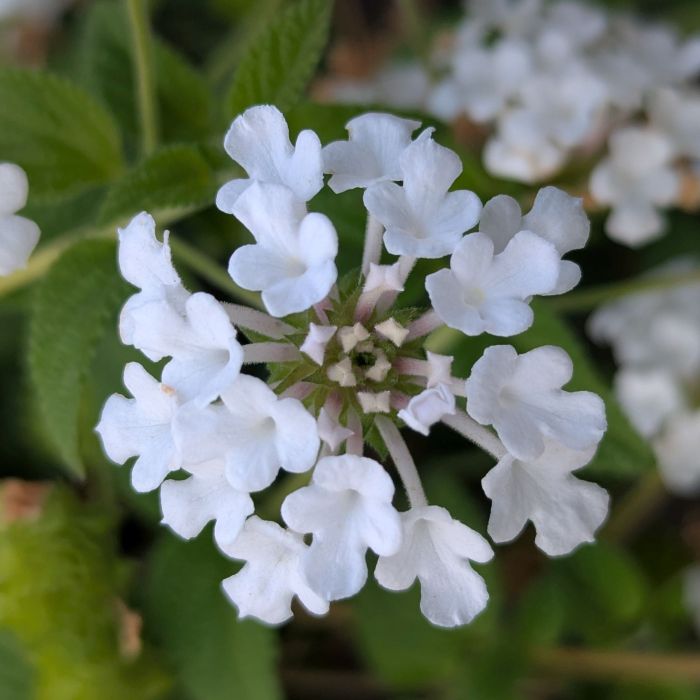
Trailing lantana trails with sprawling and thin stems. It is generally less than a foot high but can spread more than six feet wide. It can climb higher than a foot into shrubbery or other support. Its inch long leaves are strongly aromatic. Its tiny lavender flowers bloom in small, dense and circular trusses of about twenty. One cultivar exhibits white blooms.
Trailing lantana is most popular as a small-scale ground cover. It can alternatively grow with a mix of flowering perennials. It cascades nicely from big pots or elevated planters. Though undemanding, it prefers good sun exposure. Partial shade compromises bloom. Trailing lantana tolerates mediocre soils and lapses of irrigation. It is vulnerable to frost. Also, it is toxic to grazing livestock. It is readily available from nurseries, in four inch and gallon pots.
Tony Tomeo can be contacted at tonytomeo.com.